
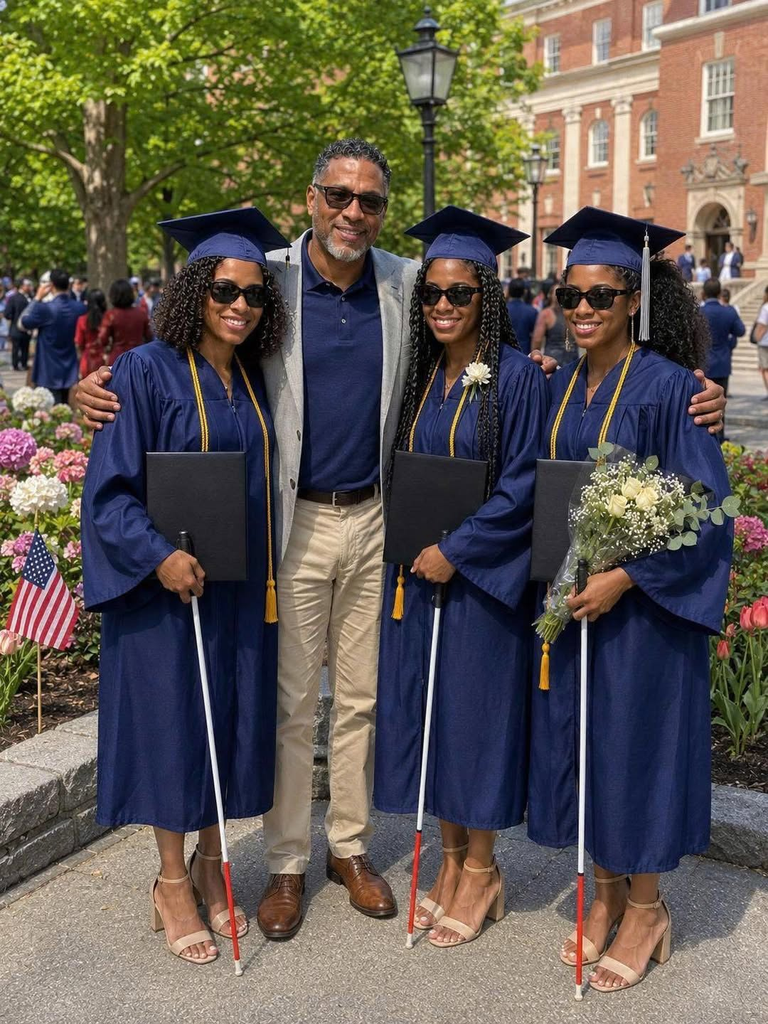
The entire auditorium went dead silent, the collective breath of four hundred people catching at once. The accusation hung in the air like heavy smoke. I turned my head slowly to look at my mother, whose face had completely drained of color. Her lips trembled, but no sound came out.
“That can’t be true,” I whispered, my voice barely audible over the hum of the air conditioning. “Mom, what is she talking about? You were there at the hospital. You helped me bring them home.”
My mother refused to meet my eyes. She stared straight ahead, her jaw locked, her eyes wide with a combination of defiance and terror. The woman who had comforted me through every teardrop and financial hardship suddenly looked like a total stranger sitting right beside me.
On stage, Clara’s twin sisters, Mia and Sophie, stood side by side behind her, their posture composed and dignified. They didn’t need sight to understand the tension vibrating through the room; their senses had been heightened over a lifetime of relying on sound, rhythm, and intuition.
“When our mother gave birth in that regional clinic eighteen years ago,” Clara continued, her voice unwavering, “she suffered severe complications. While she was unconscious in intensive care, she was told upon waking that her triplets had not survived the emergency delivery. She was given signed death certificates and ushered out of the facility before she could even hold us.”
Gasps erupted from several rows behind us. Teachers on the stage exchanged stunned glances, completely forgetting the formal program sitting in their laps. The principal stepped forward slightly, as if to intervene, but Clara raised her hand with a dignity that commanded total silence.
“She spent months in deep mourning,” Clara said, reading the embossed text from the letter that had been transcribed into Braille for her by a specialist weeks ago. “It wasn’t until a chance meeting with a clinic nurse a year later that she discovered the truth: three living, blind baby girls had been carried out of that hospital by their grandmother and taken to another town.”
I felt the ground shift beneath my feet. Images from eighteen years ago flooded my mind: my mother arriving at my small apartment with three swaddled infants, telling me that Helen had fled in the middle of the night, terrified of the responsibility, leaving a note saying she never wanted to see any of us again. I had been so overwhelmed, so broken by grief and fear, that I had accepted every single word without question.
“When she tried to come back,” Clara’s voice trembled slightly for the first time, “she was threatened with legal action and told that if she ever approached my father, he would be ruined financially by custody battles he couldn’t afford. So she did the only thing she thought would protect us. She worked two jobs, sent money anonymously to a private account set up in our names, and wrote letters every single week.”
I reached into my pocket and pulled out my phone, my hands shaking uncontrollably as I recalled an anonymous trust fund that had paid for the girls’ specialized equipment and braille books over the years. My mother had always claimed it was a grant from a regional charitable foundation.
I turned fully toward my mother. “You told me it was a state grant,” I said, my voice cracking under the weight of eighteen years of deceit. “You let me hate her. You let me tell our daughters that their mother abandoned them because they were born without sight.”
My mother finally looked at me, tears streaming down her wrinkled cheeks. “I did it for you, Arthur!” she hissed in a harsh whisper. “She was weak! She was unstable! She would have ruined your life and given up on those girls the second things got hard. I gave you a family! I saved those babies!”
Before I could answer, Clara placed the final letter down on the podium. “Our mother didn’t leave us because she didn’t love us,” Clara said, looking directly toward the back row where Helen stood tears quietly falling down her face. “She was forced into the shadows by someone who wanted total control over our lives.” ….
Clara took a deep breath and stepped back from the microphone. Mia and Sophie stepped forward, taking their sister by the arms. Together, the three of them walked down the steps of the stage, their white canes clicking rhythmically against the wooden floor in perfect unison.
The audience remained completely frozen. No one moved, no one spoke, and no one dared to interrupt the moment as the three young women guided themselves down the main aisle of the gymnasium, bypassing the rows where their schoolmates sat watching in absolute awe.
They didn’t stop at row three where I sat with my mother. They walked right past us, following the precise spatial mapping they had rehearsed in their minds since finding the dusty box in the attic.




