
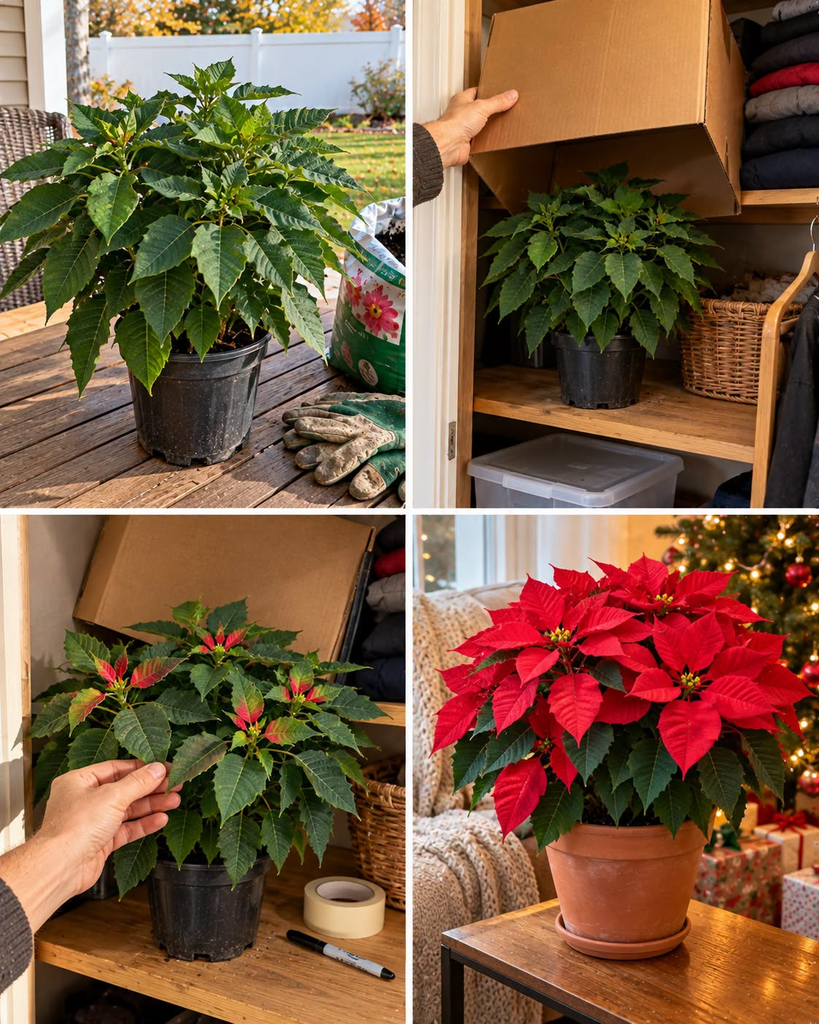
Poinsettia is the ultimate symbol of holiday cheer, yet watching a mature green plant sit stubbornly through November can test anyone’s patience. If your festive houseplant refuses to flush with those iconic scarlet leaves, the secret does not lie in commercial chemical boosters or expensive fertilizers. Instead, the secret rests entirely on mastering a strict daily lighting routine that mimics natural autumn conditions. Understanding this exact physiological trigger is the single most important step in transforming your green foliage into a vibrant holiday showpiece. 🌿
To achieve stunning crimson bracts, your poinsettia requires an uninterrupted period of absolute darkness every single evening. In its native tropical habitat, the plant responds to naturally shortening autumn days by initiating hormonal shifts that trigger flower buds and colorful leaves. Replicating this exact environment indoors takes diligence, but the breathtaking visual payoff is entirely worth the daily effort.
The Science of Photoperiodism
Poinsettias are classified as short-day plants, meaning their stunning transformation depends strictly on night length rather than temperature or watering schedules. Every single cell within the leaves responds to the balance of light and dark exposure throughout a standard 24-hour cycle.
If your plant receives even a tiny sliver of artificial illumination from a hallway lamp, streetlamp, or television screen during its required rest period, the chemical reaction stops immediately. Maintaining complete pitch-black darkness for fourteen solid hours each night is the only biological way to force the colorful pigmentation process. 💡




