
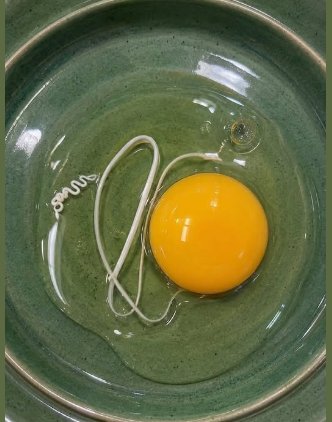
White string in egg yolk is a shocking sight when cracking an egg into a pan, often causing home cooks to freeze in disgust and wonder if their breakfast is contaminated. Have you ever cracked a fresh egg into a glass bowl only to spot a thick, squiggly white thread twisted alongside the golden yolk, immediately suspecting it might be an intestinal parasite or an embryo? Millions of people discard perfectly fresh, high-quality eggs every single day simply because they misunderstand this strange physical feature. In reality, seeing a prominent white string in egg yolk is actually a biological guarantee of exceptional freshness and high structural quality. Understanding egg anatomy and poultry physiology empowers you to cook with complete confidence, reduce unnecessary food waste, and appreciate the natural science behind fresh kitchen ingredients.
Evaluating avian biology reveals how an egg forms inside a hen’s reproductive tract. The mysterious white string is scientifically known as the chalaza (plural: chalazae). Far from being a parasite, vein, or umbilical cord, the chalaza consists of dense, twisted strands of natural protein fibers that extend from both ends of the yolk to the inner membrane of the eggshell. During egg formation in the oviduct, the yolk rotates constantly while moving through albumen layers, twisting these protein fibers tightly like spring coils. This biological mechanism suspends the delicate yolk directly in the center of the egg white, protecting it from physical impacts and preventing it from sticking against the hard outer shell.




